
Sub-Saharan Africa’s Beauty Boom: Unlocking New Growth Potential for Malaysian Palm-Based Oleochemicals

Sub-Saharan Africa is emerging as one of the fastest-growing regions for beauty and personal care products, driven by rapid urbanisation, a young population, and rising consumer purchasing power. While Malaysian palm oil already maintains a strong presence across the region’s food industries, the expanding personal care sector presents an additional avenue for growth—particularly for palm-based oleochemicals used in cosmetics, personal care and hygiene products.
Recent market data highlights the scale of this opportunity. The value of Sub-Saharan Africa’s beauty and personal care industry is projected to grow from approximately USD5.8 billion in 2019 to USD14.3 billion by 2029, reflecting significant expansion in consumer demand across multiple product segments.
Sub-Saharan Africa’s Beauty and Personal Care Industries’ Market Value in Retail Selling Price 2019–2029F (USD million)
Figure 1: Sub-Saharan Africa’s beauty and personal care industries’ market value in retail selling price, from 2019 to 2029F, in USD million (Euromonitor, 2025).
Among the key segments driving this growth are skincare, haircare, and bath and shower products—categories that rely heavily on oleochemical derivatives such as fatty acids, fatty alcohols, glycerine, and surfactants derived from palm oil. Skincare alone is forecast to nearly triple in value from USD1.2 billion in 2019 to USD3.3 billion by 2029, while the haircare segment is expected to expand from USD1.24 billion to USD2.65 billion over the same period.
These sectors depend extensively on oleochemicals for emulsifiers, moisturising agents, foaming agents, and conditioning ingredients. As demand for personal care products continues to rise across the region, the need for reliable and cost-competitive oleochemical feedstocks is expected to grow correspondingly.
Expanding Consumer Markets Across the Region
The growth of beauty and personal care consumption in Sub-Saharan Africa is being driven by several long-term structural factors. Population growth remains one of the most significant, with the region expected to account for a substantial share of global population increases over the coming decades. Urbanisation is also accelerating, bringing greater exposure to modern retail channels and international brands.
Top Markets for Beauty and Personal Care Products in Sub-Saharan Africa, 2019 versus 2029F
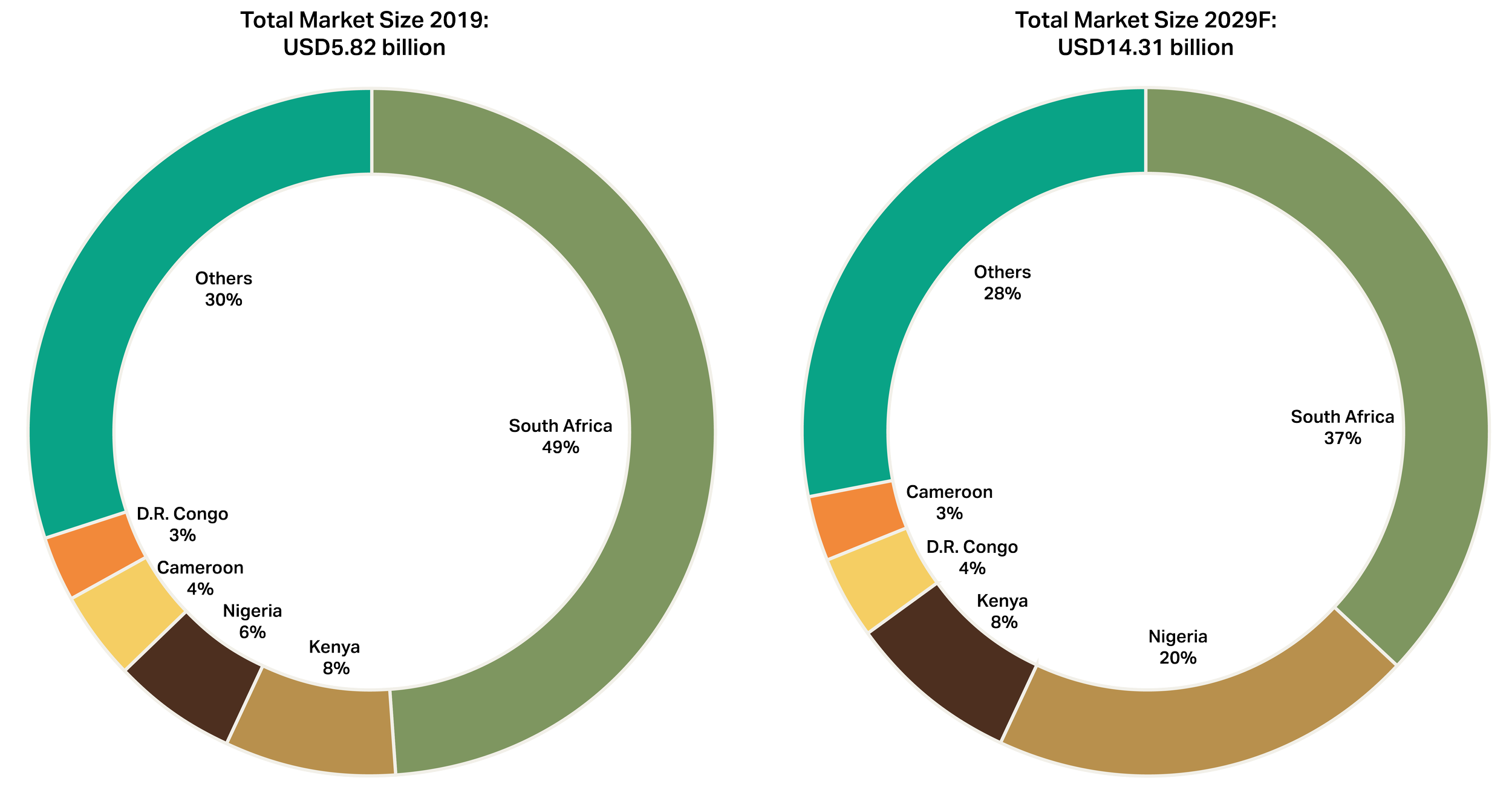
Figure 2: Top markets for beauty and personal care products in Sub-Saharan Africa, 2019 versus 2029F (Euromonitor, 2025).
South Africa remains the region’s largest beauty and personal care market, projected to grow from USD2.85 billion in 2019 to USD5.33 billion by 2029. However, several other markets are also expanding rapidly, including Nigeria, Kenya, and the Democratic Republic of Congo. Nigeria, for instance, is expected to see its market increase from USD316 million in 2019 to nearly USD2.8 billion by 2029, highlighting the rapid pace of growth in West Africa’s largest economy.
East Africa is also demonstrating steady expansion. Kenya’s market is forecast to reach USD1.08 billion by 2029, while Tanzania and Uganda are likewise experiencing gradual increases in demand for personal care products. This broad geographic spread suggests that demand for oleochemical inputs will not be concentrated in a single market, but distributed across multiple emerging economies throughout the region.
Strong Palm Oil Trade Presence, Emerging Oleochemical Market
Malaysia already maintains a strong presence in Sub-Saharan Africa’s edible oil market, particularly within the food sector. Malaysian exports of palm oil and palm-based products to the region reached 4.24 million tonnes in 2025, representing an increase of more than 11% compared to 2024.
Key destinations include Kenya, Tanzania, Togo, Nigeria, and Mozambique, which together account for a significant share of the region’s imports. Several markets recorded particularly strong growth in 2025. Tanzania’s imports of Malaysian palm oil increased by more than 45% year-on-year to reach 0.41 million tonnes, while Togo recorded growth of over 34% to 0.34 million tonnes, reflecting the region’s growing reliance on palm-based products.
Building on this strong foundation in the food sector, Malaysian palm-based oleochemicals present significant room for further expansion in Sub-Saharan Africa. In 2025, Malaysian exports of palm-based oleochemicals to the region reached 68,993 tonnes, representing an emerging but steadily growing segment within Malaysia’s broader palm-based exports. Key destinations include South Africa, Nigeria, Djibouti, Kenya and Madagascar, providing an established base that can be further developed.
This presents a clear opportunity to deepen market engagement beyond traditional palm oil consumption—particularly as downstream industrial applications—especially in cosmetics and personal care manufacturing—remain well-positioned for further uptake and growth in the region.
Opportunities for Downstream Expansion
The rapid growth of Sub-Saharan Africa’s beauty and personal care industry creates clear opportunities to expand the use of palm-based oleochemicals in local manufacturing. Many personal care products—including soaps, shampoos, and lotions—rely on palm-derived ingredients because of their versatility, affordability, and functional performance. As domestic manufacturing capacity for these products increases, demand for intermediate oleochemical ingredients is also expected to rise.
At the same time, several African countries are actively promoting industrialisation and value-added manufacturing through the local production of consumer goods. This trend could further support imports of oleochemical feedstocks used in the formulation of cosmetics, toiletries and hygiene products.
In addition, multinational consumer goods companies are steadily expanding their manufacturing footprints across Africa to serve regional markets more efficiently. These investments create valuable supply chain opportunities for oleochemical suppliers capable of delivering consistent quality, technical performance and competitive pricing.
Looking Ahead
While Malaysian palm oil already plays a central role in meeting Sub-Saharan Africa’s edible oil demand, the region’s expanding beauty and personal care industry presents a promising new frontier for palm-based oleochemicals.
As consumer markets continue to grow and local manufacturing capabilities strengthen, demand for oleochemical ingredients used in personal care formulations is expected to increase further. By deepening engagement with cosmetics and personal care manufacturers across the region, Malaysia can continue diversifying its palm-based exports while capturing emerging opportunities within Africa’s fast-growing consumer industries.
In this context, the beauty and personal care sector represents not only a complementary market for palm-based oleochemicals, but also a strategic pathway for expanding the downstream utilisation of palm oil in Sub-Saharan Africa.