
CPO Prices to Hold Above RM4,500 Amid Biodiesel Expansion and Supply Risks
Crude palm oil (CPO) prices tracked the correction in energy markets in April, despite the ongoing West Asia conflict showing no clear signs of resolution. Fluctuating decisions by the United States and Iran regarding the reopening or closure of the Strait of Hormuz contributed to heightened volatility in both energy and vegetable oil markets throughout the month.
Heading into May, palm oil prices are expected to be shaped by the following factors:
Biodiesel Demand Support
Stronger vegetable oil demand for biodiesel in key producing countries is expected to provide price support, as it effectively reduces exportable supplies. US biodiesel production reached a 15-month high in March, while in Southeast Asia, an estimated 1.0-1.5 million tonnes of palm oil are likely to be absorbed by stronger domestic demand in the second half of 2026.El Nino Weather Risk
The potential development of El Nino may provide additional support to prices. Malaysia has experienced reduced rainfall since mid-March, and these conditions are expected to persist until June.Soybean Oil Competition and South American Supply
Soybean oil prices in Argentina traded near parity with palm olein in April, as palm oil prices have risen more sharply year-to-date, potentially capping demand. Meanwhile, South American soybean exports and crushing activity are picking up seasonally ahead of harvest peak, pointing to increased supply in the global market.
A Brief Market Recap
Indonesia is set to implement B50 biodiesel from 1 July, which could absorb an additional three million tonnes of palm oil annually across both public and non-public service obligation sectors if fully realised. However, biodiesel producers may continue with B40 depending on capacity readiness, subject to the submission of implementation plans.
Thailand has also tightened controls on CPO exports effective 7 April for one year, alongside the introduction of B20 blending under its biodiesel subsidy programme. B20 is priced below B7 to encourage higher uptake and reduce reliance on imported energy. During the control period, palm oil exporters are required to obtain permits for each shipment.
Malaysia, meanwhile, has raised its blending mandate from B10 to B15 nationwide, beginning with implementation at B12, a level supported by existing infrastructure. The full transition to B15 is expected to require an additional 300,000 tonnes of palm oil annually.
Malaysia's Palm Oil Supply and Demand for March 2026
Table 4: Monthly statistics of Malaysian palm oil for March 2026 (MPOB, 2026).
Palm Oil Supply and Demand Dynamics in May: Key Changes and Trends
Malaysia’s palm oil stocks declined by 16.1% (-437,000 tonnes) to 2.26 million tonnes in March, as exports rose to 1.55 million tonnes against production of 1.37 million tonnes. The strong export performance was driven by front-loading ahead of rising shipping costs, alongside softer Indonesian exports following pre-March shipments ahead of the higher levy.
Malaysian Palm Oil Exports by Region (tonnes)

Figure 3: Malaysian palm oil exports by region (MPOB, 2026).
Despite global headwinds, exports in Q1 2026 increased by 29.1% (+927,000 tonnes) year-on-year, with shipments improving across all regions except the Americas. North Africa recorded the strongest growth at 94%, followed by South Asia (+74%), Other Europe and Central Asia (+47%), Asia Pacific (+24%) and Sub-Saharan Africa (+20%). Growth in the Middle East and EU27 was more moderate, at 8% and 1% respectively.
However, the effects of heightened price volatility in early March are likely to be felt in May and June, reflecting slower purchasing activity during March and April. For 2026, full-year exports are still projected to grow, albeit at a more moderate pace given the low base of 15.3 million tonnes in 2025. Higher biodiesel demand in Indonesia and Thailand is expected to encourage importers to shift sourcing towards Malaysia.
Palm Oil Price Outlook: Biodiesel Demand and Energy Prices to Sustain Market Support
Since the escalation of the West Asia conflict on 27 February, vegetable oil prices have moved unevenly. Palm oil and US soybean oil rose by 15-16% by mid-April, while sunflower oil, rapeseed oil and Argentine soybean oil recorded more modest gains of 2-5%. Palm oil and US soybean oil have been the primary beneficiaries of stronger biodiesel demand, supported by elevated energy prices.
Rising demand for vegetable oils in biodiesel blending across key producing countries is expected to continue supporting prices, as it reduces exportable supplies. US biodiesel production reached a 15-month high in March, with momentum expected to continue as mandates point to record biofuel usage in 2026-2027.
In Southeast Asia, an estimated 1.0–1.5 million tonnes of palm oil are expected to be absorbed by stronger domestic demand in the second half of 2026. Malaysia’s B15 mandate may require an additional 300,000 tonnes annually, while Indonesia could absorb up to three million tonnes under its B50 mandate, subject to implementation capacity.
Thailand’s move from B5 to B7 is expected to require an additional 350,000 tonnes per year, alongside tighter export controls.
Energy market uncertainty remains a key factor, as damage to infrastructure in the Middle East may take months to repair, potentially sustaining elevated energy prices. A similar pattern was observed during the Ukraine-Russia conflict in 2022, when crude oil prices remained above USD90 per barrel for several months, providing continued support to palm oil prices.
The potential development of El Nino also presents an upside risk. Reduced rainfall in Malaysia since mid-March is expected to persist until June, and if conditions materialise, production could be affected with a lag of six to nine months.
Prices of Argentine Soybean Oil and Malaysian Palm Olein (USD per tonne)
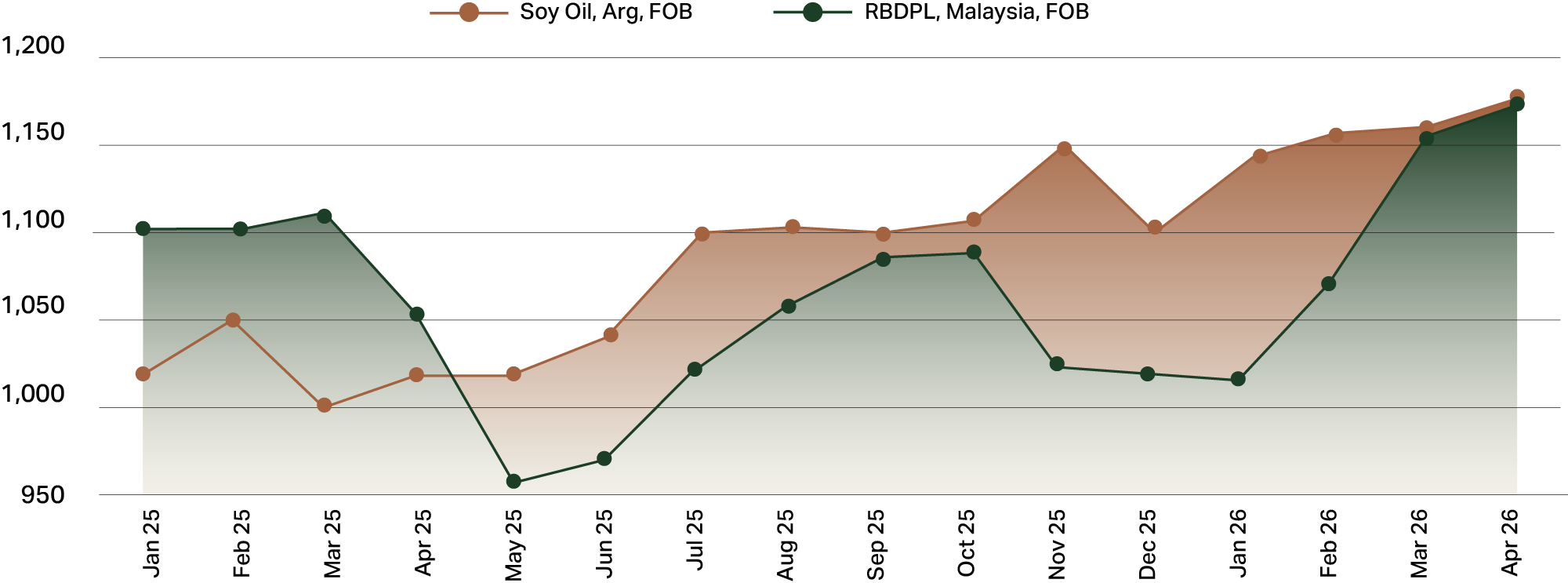
Figure 4: Price trends of Argentine soybean oil versus Malaysian palm olein (Oil World, 2026).
On the other hand, Argentine soybean oil traded near parity with palm olein in April (refer to Figure 4), as palm oil prices have risen more sharply year-to-date, potentially limiting demand.
Seasonal increases in South American soybean exports and crushing activity ahead of the May harvest peak are also expected to bring additional supply into the market.
Nevertheless, higher logistics costs from South America to Asia continue to support palm oil’s competitiveness. As of mid-April, palm oil prices in India remained approximately USD50 per tonne below soybean oil, sustaining demand in key importing markets.
Looking ahead, crude palm oil prices are expected to remain supported above RM4,500 (USD1,139) per tonne in the near term, underpinned by stronger biodiesel economics, elevated energy prices and potential El Nino developments.
However, further upside may be limited by softer export demand amid inflationary pressures and weaker economic growth in key importing countries, alongside rising stocks as palm oil production gradually enters its seasonal peak.
Exchange Rate: USD1 = RM3.95